What this piece does
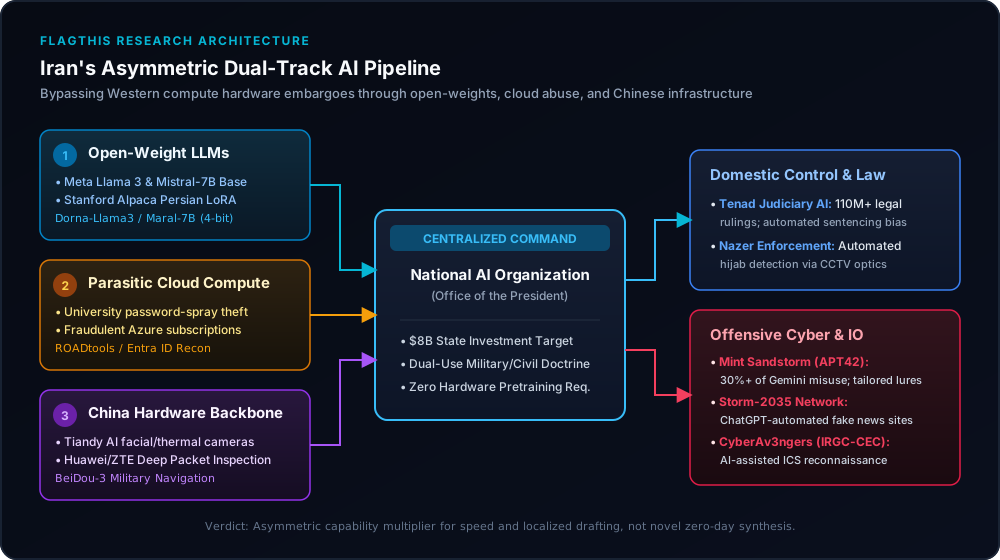
Iran cannot buy an H100. Export controls have kept the country off the leading edge of AI hardware for years, and a fragile power grid makes even mid-sized data centers a gamble. None of that has stopped Tehran from running a functioning, state-directed AI program — it has just changed the shape of it. Instead of building frontier models, Iran downloads them. Instead of building data centers, it borrows Microsoft's. Instead of waiting on domestic chip fabrication, it leans on a 25-year strategic partnership with Beijing for the hardware backbone. The result is a dual-track system: a starved commercial AI sector next to a well-resourced state apparatus purpose-built for surveillance, judicial automation, and offensive cyber operations.
That second track is the one worth tracking closely, because pieces of it show up directly in the intelligence FlagThis already indexes — the same APT groups behind Iran's AI-assisted phishing and cloud-abuse campaigns are ones we track on our Threat Actor pages, and the compute-scarcity workarounds described below (quantized open-weight models, hijacked Azure tenants) explain why those groups' tradecraft has visibly improved.
Recorded Future's threat researchers put a number on the shift: Iran's average "time-to-exploit" for a known vulnerability has fallen from several months to about five days as AI-assisted reconnaissance has taken hold — this is an outside analyst assessment, not a claim by Iranian officials themselves.
A directive from the top
The policy origin is a single speech. In November 2021, Supreme Leader Ali Khamenei named artificial intelligence an "important and futuristic issue" and ordered Iran into the world's top ten AI-producing nations — explicitly framed as resistance to Western technological dominance, not as an economic development program. Three years later, in August 2024, he sharpened the urgency: he warned that the West could eventually stand up an IAEA-style regulatory body for AI, one that would restrict advanced-model access to states it judges hostile. The read inside Iran's leadership was that a window exists now to build irreversible AI capability before any such "algorithmic sanctions regime" closes it.
That fear of a closing window, more than any commercial ambition, explains the pace of what followed. President Ebrahim Raisi's government ratified a National Artificial Intelligence Document committing roughly $8 billion in state investment and targeting AI for 12% of GDP — a program his successor, Masoud Pezeshkian, kept intact after Raisi's death in 2024.
One organization to run it all
Iran's AI policy used to be scattered across the Ministry of Communications, the Ministry of Industry, the Supreme Council of the Cultural Revolution, and assorted military branches — exactly the kind of bureaucratic fragmentation that slows a state down. Pezeshkian's government fixed that in July 2024 by standing up the National Artificial Intelligence Organization, an independent body reporting directly to the President's office. Parliament made the arrangement permanent in October 2025.
The leadership picks tell you what the organization is really for. Chairman is First Vice President Mohammad Reza Aref, a Stanford-trained electrical engineer; the operational lead is Hossein Afshin, a Sharif University of Technology professor and VP for Science, Technology, and Knowledge-based Economy. Centralizing AI under the presidency — rather than, say, a telecom regulator — is itself a signal: it puts model development, judicial automation, and security-service surveillance tooling under one command structure instead of three uncoordinated ones.
The commercial side has been left to starve by comparison. Iran's Parliament Research Center estimates AI will touch roughly 20% of existing jobs, but the state has put less than $50 million total into private-sector AI innovation — a rounding error next to the security and judicial buildout described below.
The domestic LLM stack: sovereignty on consumer hardware
Iran's answer to not having frontier-scale compute was to stop trying to compete on that axis entirely. Iranian labs and quasi-private tech firms take open-weight models published by Meta and Mistral AI and fine-tune them on Persian-language data — skipping the billions of dollars of pretraining cost that produced the base model in the first place. Persian, along with related languages like Kurdish, Balochi, and Pashto, was a genuinely low-resource language family for NLP research until fairly recently; that gap is closing fast, helped along by venues like the SilkRoadNLP workshop at EACL 2026.
Three efforts anchor the current Persian-LLM landscape:
| Model | Developer | Base Model | Parameter Scale | Persian MMLU / Bench | Operational Target |
|---|---|---|---|---|---|
| Dorna-Llama3 | PartAI (Part Software Group) | Meta Llama 3 | 8B (4-bit/8-bit GGUF) | 58.4% Persian MMLU (vs. 66.2% Llama 3 English base) | Strongest general Persian instruction model under 10B; shipped in quantized builds for single consumer GPUs. |
| Maral-7B (Alpha 1) | MaralGPT | Mistral 7B | 7B (GGUF quantized) | 51.2% Persian MMLU | Fine-tuned on translated Persian Stanford Alpaca; roughly GPT-3.5-level conversational fluency. |
| Fibonacci Series | fibonacciai | Various | 0.2B–15B | Task-specific QA | Domain-narrow models (Iran-v1, fibonacci-2-9b, RealRobot-Chatbot) aimed at e-commerce, legal parsing, and QA. |
The pattern across all three is the same: take a Western open-weight release, apply LoRA fine-tuning against a translated instruction dataset (Stanford Alpaca shows up repeatedly), and ship a quantized GGUF build that runs on a single consumer GPU. It's worth naming the second-order effect plainly — every time a Western lab open-weights a capable base model, it hands a sanctioned state a multi-million-dollar head start it would otherwise not have.
Borrowed compute: sanctions evasion, three ways
Getting a model onto a laptop is one problem. Running large-scale reconnaissance, judicial-record processing, or drone-targeting inference at national scale is a different, much bigger compute problem — and this is where Iran's actual hardware ceiling shows. The 2025 IDCA Global AI Report flags Iran's power grid, not chip access, as the binding constraint against better-resourced regional rivals like Saudi Arabia and the UAE. The country's flagship supercomputer, Simorgh at Amirkabir University of Technology, tops out in the single-digit petaflops range, and a domestic chip-fabrication effort ("Sahand") remains years from relevance under current EUV lithography export controls.
Three workarounds fill the gap:
Quantization. Shrinking an 8B-parameter model from ~16GB down to under 5GB via 4-bit/8-bit GGUF formats turns a data-center problem into a gaming-PC problem. This is the same technique behind the Dorna-Llama3/Maral-7B releases above, and it's the main reason Iran can field usable LLMs at all without EUV-grade silicon.
Parasitic cloud abuse. Rather than build data centers Iran can't power, its state-sponsored cyber units simply rent Western cloud compute using stolen credentials. Microsoft and Palo Alto Networks have both documented Iranian APT groups running the open-source ROADtools framework against Microsoft Entra ID environments — enumerating victim directories, forging authentication tokens, registering rogue devices — then standing up fraudulent Azure subscriptions (frequently funded through credentials harvested via password-spraying campaigns against universities) to host command-and-control infrastructure and run data-intensive reconnaissance for free. The operational scale of this credential theft was underscored in August 2026 when the U.S. Department of Justice indicted 17 Iranian nationals tied to the Mabna Institute for a multi-year campaign targeting hundreds of universities and research institutions worldwide to harvest credentials and exfiltrate academic data.
The North Korea playbook, potentially. Analysts also flag the possibility Iran adopts North Korea's "remote IT worker" fraud model — infiltrating Western companies as contractors to quietly use employer-provided compute and route hard currency home. There's no confirmed large-scale Iranian version of this yet, but it's a natural next step given how well the cloud-abuse playbook has already worked.
The China backstop
When neither quantization nor cloud theft is enough, Iran leans on its 2021 25-year, $300 billion Comprehensive Strategic Partnership with Beijing — hydrocarbons in exchange for infrastructure, military coordination, and technology transfer. On the AI side, four transfers matter most:
- Surveillance optics: Tiandy Technologies, the Tianjin firm behind much of Xinjiang's Uyghur surveillance apparatus, supplies the IRGC and Iranian police with AI-driven facial recognition, thermal imaging, and emotion-detection cameras.
- Deep packet inspection: Huawei and ZTE built the DPI backbone of Iran's "National Information Network" — the country's censored domestic intranet, which lets the state monitor landline, mobile, and internet traffic and "coup-proof" itself against unrest.
- Navigation: Iran's military has migrated off US GPS onto China's BeiDou-3 system for encrypted, jam-resistant positioning with a built-in short-message channel for when local telecom is cut during conflict.
- SIGINT and radar: China's satellite constellation feeds Iran signals intelligence on US/Israeli naval movement in the Persian Gulf, and Chinese UHF-band radar (YLC-8B) is tuned specifically to blunt US stealth-coating advantages.
The relationship is transactional in both directions, not just Chinese generosity — Iran functions as a live-fire test range for Chinese hardware against real US/Israeli electronic warfare, data Beijing feeds back into its own systems ahead of a possible Taiwan contingency. Iranian officials have reportedly been disappointed at how little of that partnership translates into actual military backing when conflict escalates; Beijing has stuck to diplomatic statements rather than intervention, which tells you the ceiling on this alliance.
AI on the offense: Iran's cyber units
This is the part of Iran's AI program most directly relevant to FlagThis's own tracking, and it's where the evidence gets specific enough to check claim-by-claim rather than take on faith. Two of the three groups this post tracks have primary-source-confirmed generative-AI misuse, with the frontier labs' own assessments of exactly what that use amounted to; the third doesn't, and it's worth saying so rather than assuming the "Iran uses AI" narrative applies evenly across every IRGC-linked cluster. Mint Sandstorm/APT42 has the strongest documented AI use (Google's own telemetry). CyberAv3ngers has confirmed but explicitly limited AI use (OpenAI's own telemetry). Peach Sandstorm's well-documented tradecraft — Tickler, ROADtools, cloud-abuse — has not, in the sources checked for this post, been tied to generative-AI misuse specifically; its "time-to-exploit" improvement is better explained by faster n-day weaponization and password-spray automation, tools that predate the current LLM wave.
| Threat actor | Also tracked as | Primary targets | Confirmed AI-related tradecraft |
|---|---|---|---|
| Peach Sandstorm | Refined Kitten, Elfin, APT33 | US/UAE critical infrastructure, space, oil & gas, defense | None confirmed in a primary AI-vendor report (see below). Deployed the multi-stage "Tickler" backdoor (Apr–Jul 2024) via fraudulent Azure infrastructure — conventional tradecraft, not LLM-assisted. |
| Mint Sandstorm | Charming Kitten / TA453, APT42 (naming varies by vendor — Microsoft, Mandiant, and CrowdStrike don't fully agree on where the lines between these groups sit) | High-profile individuals, academics, political campaigns, Israeli targets | Per Google's GTIG: over 30% of all Iranian APT Gemini misuse, mostly phishing-lure drafting and reconnaissance on named defense/policy experts. |
| CyberAv3ngers | Soldiers of Solomon, Shahid Kaveh Group, Hydro Kitten, Storm-0784, UNC5691 | Industrial control systems, European & Israeli infrastructure | Per OpenAI: used ChatGPT for ICS recon and debugging queries — assessed by OpenAI itself as providing no novel capability. |
Historically, Iranian phishing was often identifiable by its tells — awkward grammar, cultural misreads, stiff phrasing. LLM-assisted drafting has quietly removed that signal. Mint Sandstorm now scrapes public profiles (LinkedIn in particular) to tailor lures to a target's actual professional context, in the target's own language, without the grammatical fingerprints defenders used to key on.
The Storm-2035 playbook
Iran's AI use isn't limited to intrusion — it also runs hyperscale influence operations. OpenAI and partner researchers disrupted a network dubbed Storm-2035 in August 2024, which used ChatGPT to run a largely-automated disinformation pipeline: long-form political articles, social posts, and polarizing commentary published across a stable of fake outlets (EvenPolitics, Nio Thinker, Savannah Time, Teorator, Westland Sun) aimed at both progressive and conservative US audiences around the 2024 election. The economics here matter more than the specific takedown — an LLM turns "maintain a troll farm of human writers and translators" into "scrape trending stories and instruct a model to rewrite them with a slant," which is a cost collapse of roughly two orders of magnitude for running an influence campaign at scale.
Asymmetric coercion: Targeting U.S. critical infrastructure
While generative AI represents a potential future vector for Iranian threat actors, their immediate and most dangerous offensive operations focus on gaining direct, malicious control over U.S. critical infrastructure. These campaigns, coordinated primarily by threat actors affiliated with the Islamic Revolutionary Guard Corps (IRGC), serve as a form of low-cost, deniable asymmetric deterrence. By targeting operational technology (OT) and industrial control systems (ICS) in core sectors like Water and Wastewater Systems (WWS), Energy, and municipal Government Facilities, Tehran seeks to establish persistent leverage and project geopolitical power.
The Strategic Intent: Deterrence and Coercion
Tehran views cyber operations as a critical instrument of statecraft, allowing it to bypass conventional military disparities and project influence directly into the domestic environments of its adversaries. These attacks are rarely arbitrary; they escalate in lockstep with geopolitical tensions involving the United States and Israel. By targeting municipal water utilities and energy grids, Iranian cyber command seeks to demonstrate the capability to disrupt public safety, create panic, and impose financial costs, creating a digital "second front" to deter kinetic action or shape diplomatic outcomes.
The Historical Precedent: The Bowman Avenue Dam Intrusion (2013)
Iranian interest in U.S. industrial control systems is not a recent development. The operational foundations for these attacks were laid more than a decade ago. Between August and September 2013, an Iranian actor named Hamid Firoozi gained unauthorized access to the Supervisory Control and Data Acquisition (SCADA) systems of the Bowman Avenue Dam in Rye Brook, New York.
Firoozi was employed by ITSecTeam, an Iran-based computer security firm that performed work on behalf of entities affiliated with the IRGC. Firoozi used a cellular modem to access the dam's SCADA system, allowing him to monitor water levels, temperatures, and the operational status of the sluice gate. Critically, the level of access Firoozi obtained would have allowed him to remotely operate the sluice gate—an action that could have caused flooding in downstream residential areas—but he was blocked from doing so only because the gate was physically disconnected for maintenance at the time of the intrusion. Firoozi and six other Iranian nationals working for ITSecTeam and Mersad Co. were subsequently indicted by a U.S. federal grand jury in 2016.
Threatening Healthcare: The Boston Children's Hospital Attempt (2021)
As the IRGC's cyber command matured, their targets expanded from physical structures to critical services. In the summer of 2021, Iranian state-sponsored actors initiated a cyberattack targeting the network of Boston Children's Hospital.
The attackers gained initial access by exploiting a known Fortinet FortiOS SSL VPN vulnerability (CVE-2018-13379) on exposed network appliances, preparing to deploy ransomware or wiper payloads that would disable the hospital’s electronic health records, administration systems, and medical networks. The operation was disrupted before the actors could execute the payload: the FBI, alerted by an international intelligence partner, tipped off the hospital’s security team on August 3, 2021. The hospital mitigated the exposed access points and isolated the compromised systems, preventing a potentially catastrophic disruption of pediatric critical care. FBI Director Christopher Wray later characterized the attempted breach as "one of the most despicable cyberattacks" because of the deliberate selection of a pediatric hospital.
OT Exploitation Escalates: The Aliquippa Unitronics Breach (2023)
In November 2023, the IRGC Cyber-Electronic Command (IRGC-CEC) shifted its focus back to physical OT systems, deploying an active operational front under the persona CyberAv3ngers (also tracked as the Shahid Kaveh Group).
The group targeted the Municipal Water Authority of Aliquippa, Pennsylvania, compromising a remote booster station that regulated water pressure for local townships. The attackers exploited internet-exposed Unitronics programmable logic controllers (PLCs) with built-in HMIs (CVE-2023-6448). Rather than writing complex exploit payloads, the threat actors simply logged in using the manufacturer's default administrative password (1111) which had been left unchanged. Once inside, they disabled the PLC's normal ladder logic, took control of the pressure monitoring, and defaced the HMI screen with a political message: "You have been hacked, down with Israel." While the utility successfully pivoted to manual operations with no disruption to water supply or safety, the incident illustrated the vulnerability of municipal infrastructure to low-skill, high-impact opportunistic attacks. The same campaign compromised at least 75 other exposed Unitronics devices across the United States, United Kingdom, Israel, and Ireland.
The 2026 Multistate PLC Exploitation Campaign (AA26-097A)
By early 2026, the IRGC's infrastructure campaign expanded into a coordinated, vendor-agnostic offensive. According to CISA joint advisory AA26-097A, updated in July 2026, Iranian-affiliated APT actors launched a multistate campaign targeting exposed PLCs across 12 U.S. states.
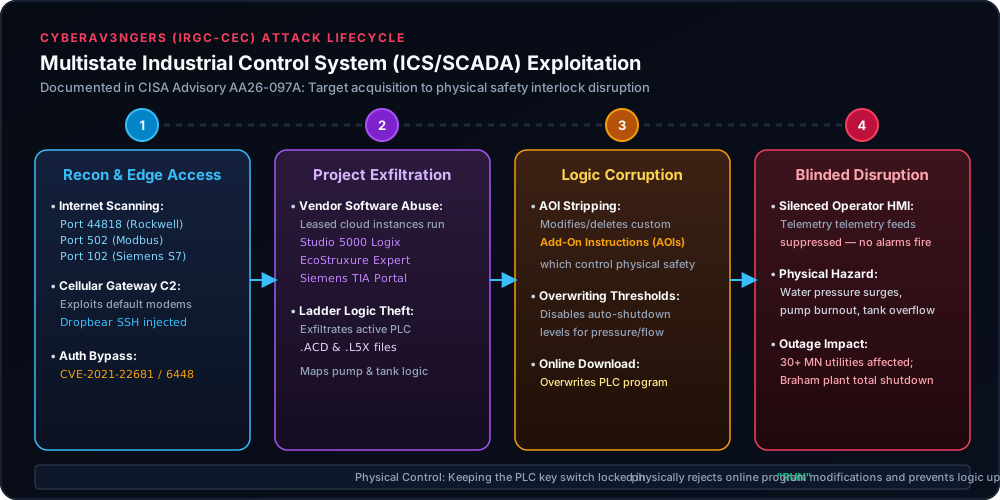
The campaign's impact was most severe in Minnesota, where over 30 community water systems experienced operational disruptions, including a total plant outage in Braham, forcing several municipal utilities to issue conservation and boil-water notices due to the loss of remote telemetry. The technical execution of this campaign represents a significant shift from the simple HMI defacements of 2023:
- Expanded Target Scope: The actors moved past Unitronics devices to target CompactLogix and Micro850 PLCs (Rockwell Automation/Allen-Bradley), BMX P34 and Modicon M340 PLCs (Schneider Electric), and S7-1200 series PLCs (Siemens).
- Initial Access & Persistent C2: Threat actors scanned the internet for protocols exposed on cellular modems and PLCs, targeting port 44818 and 2222 (Rockwell), port 502 (Schneider Modbus), port 102 (Siemens S7), and port 22 (SSH). On cellular modems, they deployed Dropbear SSH software to establish persistent remote access.
- Configuration Abuse & Exfiltration: The attackers used leased, third-party hosting infrastructure running the vendors' own legitimate engineering software—Rockwell's Studio 5000 Logix Designer, Schneider's EcoStruxure Control Expert, and Siemens' Totally Integrated Automation (TIA) Portal—to exfiltrate PLC project files (such as Rockwell's
.ACDprogram files). - Logic Deletion and Bypassing Safety: The threat actors modified the ladder logic within the exfiltrated project files and uploaded the corrupted programs back to the PLCs. A critical technique involved modifying or completely deleting custom Add-On Instructions (AOIs)—reusable code blocks that control specific safety interlocks. By disabling these AOIs, the actors disabled automatic safety shutdown thresholds and alarm parameters. As a result, the industrial systems could enter unsafe states (e.g., overpressure, tank overflow, or pump burnouts) without triggering alarms on operator HMI/SCADA screens, rendering the operators blind to physical anomalies.
Hardening and Defensive Architecture
Mitigating the threat of malicious control requires moving away from the default, internet-exposed architectures that make opportunistic scanning successful:
- OT Network Segregation: PLCs and telemetry endpoints must be completely disconnected from the public-facing internet. Any remote monitoring or maintenance must be brokered through a secure gateway (jump host) situated in a DMZ, requiring phishing-resistant Multi-Factor Authentication (MFA) to access.
- Physical Switch Enforcement: For PLCs equipped with physical mode switches (such as CompactLogix controllers), the physical key switch must be placed in the RUN position. This locks the active logic in place, physically preventing the download of modified project files or online logic modifications via configuration software. The key should only be turned to "Remote" or "Program" during active maintenance windows and locked back to "Run" immediately after.
- Secure Cellular Telemetry: Cellular modems used for remote field access must be configured with private Access Point Names (APNs), site-to-site VPNs, or Zero Trust Network Access (ZTNA). Cellular modems should have all unused management protocols (Telnet, FTP, RDP, VNC) disabled.
- Logic Verification: Asset owners must maintain offline, secure backups of verified PLC project files. Security teams should regularly use manufacturer comparison tools to cross-reference the running code on production controllers against the baseline to detect unauthorized changes to Add-On Instructions (AOIs) or configuration settings.
Detection engineering: cloud abuse and ICS integrity
To defend against Iranian cloud-theft operations and OT logic manipulation, security teams can deploy proactive KQL detections and automated PLC baseline verification engines:
1. Microsoft Sentinel KQL: Detecting ROADtools Entra ID reconnaissance & cloud abuse
Iranian operators (Peach Sandstorm, Mint Sandstorm) systematically abuse the ROADtools framework against Microsoft Entra ID to dump tenant directories and forge device tokens. This query detects high-volume Graph API enumeration paired with rapid non-corporate device registration:
// Detect ROADtools Graph API enumeration & rogue device additions
let timeWindow = 1h;
let highVolumeThreshold = 50;
AuditLogs
| where TimeGenerated >= ago(24h)
| where OperationName in ("Add device", "Register device", "Add registered owner to device")
    or (LoggedByService =~ "Core Directory" and OperationName has "Enumerate")
| extend Initiator = tostring(InitiatedBy.user.userPrincipalName)
| extend ClientApp = tostring(AdditionalDetails[0].value)
| where ClientApp has_any ("ROADtools", "Python", "PowerShell", "curl")
    or UserAgent has_any ("ROADtools", "python-requests", "aiohttp")
| summarize
    DeviceAddCount = countif(OperationName has "device"),
    Operations = make_set(OperationName, 20),
    IPAddresses = make_set(CallerIPAddress, 10)
    by Initiator, bin(TimeGenerated, timeWindow)
| where DeviceAddCount >= 2 or array_length(Operations) >= highVolumeThreshold
| project TimeGenerated, Initiator, DeviceAddCount, Operations, IPAddresses
| order by TimeGenerated desc
2. Rockwell Studio 5000 / L5X Add-On Instruction (AOI) integrity checker
CyberAv3ngers' core technique against municipal water controllers is modifying or deleting safety Add-On Instructions (AOIs) in exfiltrated .L5X / .ACD project files. This script parses production XML exports against an offline baseline to flag unauthorized logic tampering:
#!/usr/bin/env python3
"""
AOI Integrity Checker: Audits Rockwell Automation RSLogix / Studio 5000 (.L5X)
project files to detect unauthorized deletion or modification of safety Add-On Instructions (AOIs).
"""
import xml.etree.ElementTree as ET
import hashlib
import sys
from typing import Dict, Tuple

def parse_aoi_definitions(l5x_path: str) -> Dict[str, Tuple[str, str]]:
    """Extracts Add-On Instructions (AOIs) and generates cryptographic signatures."""
    tree = ET.parse(l5x_path)
    root = tree.getroot()
    aois = {}

    # Locate all AddOnInstructionDefinitions in Rockwell L5X XML
    for aoi in root.findall(".//AddOnInstructionDefinition"):
        name = aoi.get("Name", "UNKNOWN")
        revision = aoi.get("Revision", "1.0")

        # Serialize routine content to compute normalized SHA-256 hash
        routines = aoi.findall(".//Routine")
        routine_text = ""
        for r in routines:
            for line in r.itertext():
                routine_text += line.strip()

        digest = hashlib.sha256(routine_text.encode("utf-8")).hexdigest()
        aois[name] = (revision, digest)

    return aois

def audit_plc_project(baseline_l5x: str, running_l5x: str):
    print(f"[*] Comparing running PLC logic '{running_l5x}' against baseline '{baseline_l5x}'...")
    base_aois = parse_aoi_definitions(baseline_l5x)
    live_aois = parse_aoi_definitions(running_l5x)

    tampered = False
    # Check for deleted safety AOIs
    for name, (rev, digest) in base_aois.items():
        if name not in live_aois:
            print(f"[!] CRITICAL ALERT: Add-On Instruction '{name}' has been DELETED in running controller!")
            tampered = True
        elif live_aois[name][1] != digest:
            print(f"[!] WARNING: Add-On Instruction '{name}' logic has been MODIFIED (Hash mismatch)!")
            tampered = True

    # Check for unauthorized newly injected AOIs
    for name in live_aois:
        if name not in base_aois:
            print(f"[?] CAUTION: Unrecognized Add-On Instruction '{name}' detected in running program!")
            tampered = True

    if not tampered:
        print("[+] SUCCESS: All Add-On Instructions match offline verified safety baseline.")

if __name__ == "__main__":
    if len(sys.argv) == 3:
        audit_plc_project(sys.argv[1], sys.argv[2])
    else:
        print("Usage: python aoi_checker.py <baseline_project.L5X> <production_project.L5X>")
The paper trail: malware, CVEs, and infrastructure
Everything above describes behavior. This section is the receipts — the specific malware families, exploited CVEs, MITRE ATT&CK identifiers, and named individuals public reporting has actually attributed to these three actors, so the claims above aren't just narrative. Every CVE here links to its FlagThis tracking page.
Peach Sandstorm / APT33 (MITRE G0064)
Peach Sandstorm's initial-access playbook increasingly leans on exploiting n-day vulnerabilities with public proof-of-concept code rather than custom zero-days. Microsoft has attributed exploitation of CVE-2022-47966 (a Zoho ManageEngine remote-code-execution flaw) and CVE-2022-26134 (an Atlassian Confluence RCE) directly to the group for initial access, on top of its long-running password-spray campaigns.
Once inside, the group's tooling spans a genuine mix of custom code and repurposed open-source red-team frameworks:
| Tool | Type | What it's for |
|---|---|---|
| Tickler | Custom multi-stage backdoor | The Apr–Jul 2024 campaign; Microsoft's writeup names the dropped files Network Security.zip (a decoy archive bundled with real PDFs) and sold.dll (the actual Trojan dropper). |
| FalseFont | Custom backdoor | Documented separately targeting the defense industrial base; see Nextron Systems' analysis. |
| ROADtools / AzureHound | Open-source Entra ID recon (abused) | Legitimate, publicly maintained red-team tooling on GitHub, reused post-compromise to map victim tenants. |
| Quasar RAT | Open-source .NET RAT (abused) | Freely available on GitHub; CISA has separately flagged Quasar as a tool of choice across many APT groups, not unique to Iran. |
| PoshC2, Pupy | Open-source C2/RAT frameworks (abused) | Commodity red-team tooling per Malpedia's APT33 profile, alongside leaked/commercial RATs (NanoCore, DarkComet, NetWire, Remcos) the group has used opportunistically since 2013. |
Its cloud infrastructure follows the pattern described above: fraudulent Azure-for-Students subscriptions, created with compromised university credentials, hosting the C2 for Tickler and other campaigns.
On AI specifically: we did not find a primary-source report — from Microsoft, OpenAI, or Google — documenting Peach Sandstorm's own use of generative AI, despite that being the framing this post (and its source material) initially reached for. Worth being precise about which Iranian actor was named: Microsoft and OpenAI's joint February 2024 report on nation-state LLM misuse documented Iranian use of ChatGPT for reconnaissance and social-engineering assistance, but attributed it to Crimson Sandstorm (MITRE G1012; also tracked as Tortoiseshell, Imperial Kitten, CURIUM, TA456) — a separate IRGC-linked cluster this post doesn't otherwise track, distinct from Peach Sandstorm/APT33. It's a useful reminder that "Iran's APTs use AI" doesn't automatically transfer between named clusters; each needs its own citation.
The Charming Kitten cluster (MITRE G0059 / G1044)
The naming mess here is real and worth stating plainly rather than glossing over: Microsoft's "Mint Sandstorm," Mandiant's "APT42," and Proofpoint's "TA453" overlap substantially but aren't a guaranteed 1:1 mapping, and MITRE tracks them as two separate group entries — G0059 for the older TA453/Charming Kitten cluster, G1044 specifically for APT42. Tooling attributed across the cluster includes PINEFLOWER (an Android implant), TAMECAT (a PowerShell-based backdoor), and NICECURL (a VBScript implant), all cataloged in MITRE's G1044 entry. The cluster shares Peach Sandstorm's habit of running ROADtools against Entra ID once inside a victim's cloud tenant.
This is also the strongest-documented AI misuse case of the three. Google's Threat Intelligence Group (GTIG) reported in January 2025 that Iranian government-backed actors accounted for the largest share of state-linked Gemini misuse of any country tracked, spanning more than 10 distinct Iran-backed groups — and that APT42 alone was responsible for over 30% of that activity. GTIG's breakdown of what APT42 actually used Gemini for: drafting and localizing phishing content aimed at specific US and Israeli defense/policy experts, reconnaissance on those same targets, vulnerability research (GTIG specifically calls out lookups against Mikrotik, Apereo, and Atlassian products), and — the more striking item — direct technical questions about US aerospace and missile-defense systems, including F-35 capabilities and Israeli anti-drone systems. GTIG's own conclusion, stated plainly rather than hedged into ambiguity: "We do not see indications of them developing novel capabilities," and separately, "Gemini's safety and security measures restricted content that would enhance adversary capabilities." The volume of use is real and worth taking seriously; the capability uplift, per Google's own analysts, is not yet a breakthrough.
CyberAv3ngers (MITRE G1027)
This is the most heavily attributed of the three. CyberAv3ngers — also tracked as Soldiers of Solomon, the Shahid Kaveh Group, Hydro Kitten, Storm-0784, Bauxite, Mr. Soul, and UNC5691 — is a front for the IRGC's Cyber-Electronic Command (IRGC-CEC). In an unusually direct move, the U.S. Rewards for Justice program named six individuals it assesses are behind the group's US-facing operations, offering a $10 million reward for information leading to their identification: Hamid Homayunfal, Hamid Reza Lashgarian (head of the IRGC-CEC and, separately, an IRGC-Qods Force commander), Mahdi Lashgarian, Milad Mansuri, Mohammad Amin Saberian, and Mohammad Bagher Shirinkar.
The group's exploitation chain is unusually well-documented because it's been running against US critical infrastructure continuously since 2023:
- CVE-2023-6448 — Unitronics Vision/Samba PLCs and HMIs ship with a default administrative password (
1111). This is the root cause of the November 2023 breach of the Municipal Water Authority of Aliquippa, Pennsylvania, and at least 75 other Unitronics devices compromised across the US, UK, Israel, and Ireland through January 2024, per CISA advisory AA23-335A. Compromised HMIs displayed a defacement message: "You have been hacked, down with Israel." - CVE-2021-22681 — an unpatched authentication bypass in Rockwell Automation Logix controllers, added to CISA's Known Exploited Vulnerabilities catalog in March 2026 after confirmed CyberAv3ngers exploitation.
- CVE-2023-3595 and CVE-2024-6242 — additional Rockwell ControlLogix/Logix vulnerabilities (remote code execution and a "Trusted Slot" security-feature bypass, respectively) named alongside CVE-2021-22681 in FlagThis's own coverage of the July 26–27, 2026 attack on 30+ Minnesota water utilities, where CyberAv3ngers used IOCONTROL and the vendors' own engineering tools to reach what that reporting calls "Phase 4" capability and claimed the campaign was retaliation for "Operation Epic Fury."
- IOCONTROL — custom malware targeting IoT/OT gear from Baicells, D-Link, Hikvision, and Red Lion, per Rewards for Justice.
On the AI question specifically: OpenAI's October 2024 disruption report confirms CyberAv3ngers used ChatGPT, and is specific about what for — queries about "industrial ports and protocols that can connect to the internet," "industrial routers and PLCs commonly used in Jordan," default passwords for named devices (Tridium Niagara systems, Hirschmann RS industrial routers), plus general vulnerability-scanning and malware-obfuscation questions. OpenAI's own verdict on what that use amounted to: it "did not provide CyberAv3ngers with any novel capability, resource, or information, and only offered limited, incremental capabilities that are already achievable with publicly available, non-AI powered tools." Read literally, that means the group's actual intrusions — the Unitronics and Rockwell/Schneider/Siemens campaigns below — are not shown to depend on the AI use; the AI use is confirmed and real, but as reconnaissance convenience, not as the thing that made the intrusions possible. The same OpenAI report also flagged a second, less-tracked Iranian group, Storm-0817, using ChatGPT for Android malware development and social-media scraping — outside this post's scope, but a sign the pattern isn't limited to the three actors tracked here.
CISA's updated advisory AA26-097A (April, expanded July 2026) shows the campaign has since widened well past Unitronics — to Schneider Electric (BMX P34 / Modicon M340) and Siemens (S7-1200 series) controllers — using the vendors' own legitimate engineering software (Rockwell Studio 5000, Schneider EcoStruxure Control Expert, Siemens TIA Portal) over exposed remote access, plus Dropbear SSH, rather than novel exploit code (Trend Micro's independent analysis of the July update reaches the same read, and stresses the safety-interlock tampering detailed above as evidence of physical-consequence intent). The group's public-facing presence is its Telegram channel, @CyberAveng3rs, launched in September 2023, which it uses to publish target lists and claim credit — most recently for an August 2026 coordinated attack on Minnesota municipal water-utility SCADA/ICS systems, which the group described as "only to warn." FlagThis's own tracking has followed this directly: our coverage of the Minnesota SCADA/ICS attacks is linked in the Related Intelligence panel.
Outside the surface web
None of the three actors tracked in this post has a confirmed, stable Tor/.onion presence in current public reporting — their claims channels are Telegram, not dark-web forums. The wider Iranian state-linked ecosystem does run hack-and-leak infrastructure reachable over Tor, though: CISA advisory AA24-241A covers Iran-based actors enabling ransomware operations with dedicated leak sites, and groups like Pay2Key (tracked as HomeLand Justice / Nemesis Kitten) and the hacktivist-branded Handala Hack persona both maintain Tor hidden services alongside Telegram and BreachForums accounts. We're deliberately not publishing specific onion addresses here — they rotate, and a stale one printed in a research post is worse than useless — but they're discoverable through the CISA advisory and the dark-web threat-intel trackers cited in Sources below if you need them for defensive blocklisting.
AI on the inside: judiciary and street-level policing
The most mature, least ambiguous application of Iranian state AI is domestic, not offensive.
Tenad, the judiciary's AI system, is trained on more than 110 million historical rulings and legal records, and is used to standardize sentencing, locate a citizen's financial assets in minutes, and auto-issue legal certificates. The structural problem is not subtle: a model trained on rulings from a judiciary widely documented for arbitrary detention and forced confessions will learn — and then systematize — that judiciary's biases. Filterwatch's investigative reporting documents that Iran's Supreme Court uses "alignment with the model's recommendation" as an official performance evaluation metric for judges, which creates a structural feedback loop actively penalizing judges who deviate from the AI's historically harsh baseline.
Nazer, a facial-recognition enforcement app, is the direct policy response to the 2022 "Woman, Life, Freedom" protests: rather than risk more street confrontations over hijab enforcement, the state moved enforcement into automated, remote detection. Built on Chinese CCTV and drone hardware (Tiandy Technologies) and interaction-tracking software in the style of FindFace, Nazer flags non-compliant individuals for automatic fines, vehicle impoundment, or arrest. The UN's Independent International Fact-Finding Mission on Iran has specifically called out the "chilling" effect of always-on automated enforcement with no meaningful appeal path.
The military dimension
IRGC commanders have been explicit that centralized AI governance is meant to speed up military decision cycles and improve targeting. Iran is watching the same AI-assisted targeting systems everyone else is — Israel's "Lavender" and "Gospel," the US military's Project Maven — and drawing the obvious conclusion that modern targeting speed is now an algorithmic problem. As documented in SpecialEurasia's strategic intelligence analysis, Chinese SIGINT sharing from the Persian Gulf and Russian combat-data exchanges from Ukraine feed Iranian research into autonomous drone swarms and supersonic missile guidance (such as the CM-302 anti-ship platform).
There's also a colder read from Iranian analysts on the defensive side: LLM sycophancy — models tending to confirm a user's existing assumptions rather than challenge them — is being studied as an exploitable weakness in how adversaries use AI for military planning, not just a curiosity.
Timeline
| Date | Event | Why it mattered | Source |
|---|---|---|---|
| Aug 2013 | Bowman Avenue Dam SCADA intrusion | Hamid Firoozi accesses dam controls via cellular modem; remote gate control blocked only because the gate was physically disconnected for maintenance. | U.S. Department of Justice |
| Mar 2016 | Indictment of ITSecTeam/Mersad actors unsealed | Seven Iranians, including Hamid Firoozi, indicted for the 2013 dam hack and DDoSing U.S. banks on behalf of the IRGC. | FBI Profile: Hamid Firoozi |
| Mar 2021 | Sino-Iranian 25-year Strategic Partnership signed | Locked in the Chinese hardware/surveillance pipeline described above. | American Foreign Policy Council |
| Jun–Aug 2021 | Boston Children's Hospital attack disrupted | FBI alerts hospital to imminent Iranian ransomware/wiper threat targeting Fortinet VPN; network access mitigated before patient care is disrupted. | Department of Justice Speech |
| Nov 2021 | Khamenei's top-10 AI directive | Reframed AI as national-security policy, not commercial development. | Iranian Studies (Cambridge) |
| Late 2022–2023 | "Woman, Life, Freedom" protests | Triggered the pivot to Nazer-style automated enforcement. | Al-Monitor |
| Dec 2023 | National AI Steering Committee established | First formal centralization attempt under Raisi. | Filterwatch |
| Nov 2023 | CyberAv3ngers exploit Aliquippa Water Authority | IRGC-CEC persona hacks Unitronics PLCs via default "1111" admin passwords, defacing HMIs and prompting manual water operations. | CISA AA23-335A |
| Apr–Jul 2024 | Peach Sandstorm deploys "Tickler" | First widely-documented use of fraudulent Azure infra for a live backdoor campaign. | Microsoft Security Blog |
| Jun 2024 | National Artificial Intelligence Document approved | Formalized the $8B/12%-of-GDP investment target and the Tenad rollout. | Filterwatch |
| Jul 2024 | National AI Organization launched | Centralized command under the Presidency. | Filterwatch |
| Aug 2024 | Storm-2035 disrupted by OpenAI | First confirmed large-scale Iranian use of ChatGPT for influence-op content generation. | OpenAI |
| Oct 2025 | National AI Organization codified by Parliament | Made the centralized structure permanent. | Filterwatch |
| Apr 2026 | CISA publishes alert AA26-097A | Warns of active exploitation of Rockwell Automation PLCs by Iranian threat actors. | CISA AA26-097A |
| Jul 2026 | CISA updates AA26-097A | Expands scope to Siemens and Schneider Electric PLCs; adds AOI detection logic. | CISA AA26-097A |
| Aug 2026 | DOJ indicts 17 Mabna Institute operatives | Indictment details multi-year academic credential theft and password spraying fueling Iranian cloud infrastructure abuse. | U.S. DOJ / FlagThis |
The bottom line
Iran's AI program is best understood as compensation, not catch-up. Export controls closed off frontier hardware, so Tehran fine-tuned freely available open-weight models instead of training from scratch, rented stolen Western cloud capacity when local compute ran out, and leaned on a Chinese hardware pipeline for everything sanctions couldn't buy — and built a state apparatus that is genuinely capable at surveillance, judicial automation, and offensive cyber operations as a result. But the generative-AI piece of that offensive tooling, per the AI labs' own telemetry rather than secondhand claims, has so far bought faster reconnaissance and better-written phishing, not a new capability nobody had before. Both halves of that finding matter: the investment and the operational tempo are real and still accelerating, and the "AI breakthrough" framing that shows up in a lot of adjacent coverage isn't yet backed by the people best positioned to know, OpenAI's and Google's own safety teams.
This is a maintained page, not a one-time snapshot — CISA's PLC-campaign advisory update and CyberAv3ngers' claimed Minnesota water-utility attack both landed after this post's first draft and are already folded into "The paper trail" above rather than left as a dated addendum. We'll keep doing that as Iran's tradecraft, AI use, or the sanctions picture around it changes; see the revision history below for what's already changed since this went up.
Sources
- Iran's AI Ambitions: Balancing Economic Isolation with National Security Imperatives — Recorded Future
- AI Has Enhanced Iran's Asymmetric Playbook During the 2026 Conflict — Recorded Future
- Iran and the Artificial Intelligence Revolution — JISS
- Control Over Innovation: Iran's Paradoxical AI Development (Part 1) — Filterwatch
- The Black Box of the Judiciary: Inside Iran's AI Transformation (Part 2) — Filterwatch
- Artificial Intelligence in Iran: National Narratives and Material Realities — Iranian Studies (Cambridge)
- Military Intelligence Benefits for China in the US-Israel War Against Iran — SpecialEurasia
- Paved With Intent: ROADtools and Nation-State Tactics in the Cloud — Unit 42
- Iranian hackers 'tickle' targets in US, UAE with custom tool — CyberScoop
- Chinese Tech Is Powering Iran's Repression — American Foreign Policy Council
- Iran turns to tech to crush dissent: UN probe — Al-Monitor
- Disrupting a covert Iranian influence operation — OpenAI
- Peach Sandstorm deploys new custom Tickler malware — Microsoft Security Blog
- Peach Sandstorm password spray campaigns enable intelligence collection — Microsoft Security Blog
- Analysis of FalseFont Backdoor used by Peach-Sandstorm — Nextron Systems
- APT33, HOLMIUM, Elfin, Peach Sandstorm (G0064) — MITRE ATT&CK
- APT33 (Threat Actor) — Malpedia
- Quasar Open-Source Remote Administration Tool (AR18-352A) — CISA
- ROADtools — GitHub (dirkjanm)
- Magic Hound, TA453, Charming Kitten, Mint Sandstorm (G0059) — MITRE ATT&CK
- APT42 (G1044) — MITRE ATT&CK
- CyberAv3ngers, Soldiers of Soloman (G1027) — MITRE ATT&CK
- CyberAv3ngers — Rewards for Justice (U.S. Department of State)
- IRGC-Affiliated Cyber Actors Exploit PLCs in Multiple Sectors (AA23-335A) — CISA
- Iranian-Affiliated Cyber Actors Exploit Programmable Logic Controllers (AA26-097A) — CISA
- Iran-based Cyber Actors Enabling Ransomware Attacks (AA24-241A) — CISA
- Hacking group linked to Iran claims responsibility for Minnesota water-system attack — KSTP
- Dark Web Profile: Cyber Av3ngers — SOCRadar
- OpenAI Says Iranian Hackers Used ChatGPT to Plan ICS Attacks — SecurityWeek
- Federal Agencies Warn of Ongoing PLC Exploitation Against Critical U.S. Infrastructure — Trend Micro
- Adversarial Misuse of Generative AI (GTIG, January 2025) — Google Cloud Blog
- Staying ahead of threat actors in the age of AI — Microsoft Security Blog
- CURIUM, Crimson Sandstorm, TA456, Tortoise Shell, Yellow Liderc (G1012) — MITRE ATT&CK
- Seven Iranians Working on Behalf of Iranian Government Indicted for Conducting Coordinated Campaign of Cyber Attacks — U.S. Department of Justice
- FBI Wanted Profile: Hamid Firoozi — FBI
- Director Christopher Wray's Remarks on Boston Children's Hospital Cyber Threat — U.S. Department of Justice
- US DOJ Indictment of Mabna Institute for State-Sponsored Espionage — FlagThis